Singapore Manufacturing Stable

Singapore’s manufacturing sector stayed resilient in May as electronics and AI demand offset weakness in biomedicals and chemicals, supporting the outlook for GDP and supply chains

2026.06.27 · 6 Reads · Source: 邦谷环球投研
Singapore Manufacturing Stable
配图

Singapore’s Manufacturing Sector Holds Up as Electronics and AI Demand Offset Broader Weakness

Keywords: Singapore manufacturing, electronics industry, AI demand, chemical sector, biomedicals, economic forecast, supply chains, GDP outlook

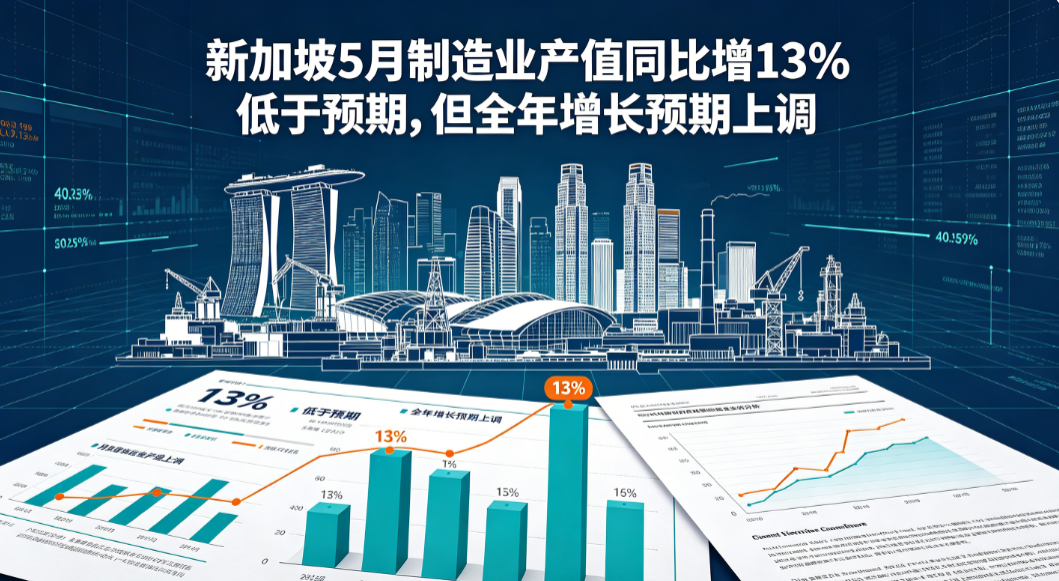
Singapore’s manufacturing sector delivered a mixed but broadly resilient performance in May, even as two key segments — biomedicals and chemicals — continued to contract. According to preliminary estimates released by the Economic Development Board (EDB) on Friday, manufacturing output rose 13% year on year in May. While this was weaker than the 16.1% forecast by the market and below April’s 16.5% increase, the underlying picture suggests that the sector remains on solid footing, supported by strong electronics activity and improving expectations for the months ahead.

The latest figures show a manufacturing landscape marked by divergence. Some industries, especially electronics, are benefiting from the artificial intelligence (AI) investment cycle, while others are still grappling with supply disruptions and soft external conditions. Economists say this unevenness is likely to persist in the near term, but they also see reasons for optimism — enough to justify upward revisions to Singapore’s full-year economic growth outlook.

Electronics Continues to Lead the Way

Among the major manufacturing clusters, electronics once again emerged as the strongest performer in May, posting a sharp 35.8% year-on-year expansion. Within the segment, information communication and consumer electronics surged 59.2%, while the semiconductor subsector rose 37%. These figures highlight the extent to which Singapore remains embedded in the global technology supply chain, especially in high-value segments linked to AI infrastructure.

Economists note that the current AI boom is not just a short-lived market theme. It is translating into tangible capital expenditure by major cloud service providers, who continue to invest heavily in data centers, servers, and storage systems. This, in turn, supports demand for semiconductors, server-related equipment, and other electronic components produced in Singapore.

Starters of the latest rebound are not merely cyclical. The AI investment wave appears to be structural, at least over the medium term, with large-scale infrastructure projects requiring sustained orders for advanced manufacturing inputs. This has become a critical pillar for Singapore’s industrial economy at a time when other sectors are under pressure.

Senior economist Chua Han Teng of DBS Bank said the slowdown in May should not be interpreted as a sign of weakness in the broader manufacturing base. In his view, the sector remains “quite strong” overall, and future growth is likely to continue being driven by electronics. He added that cross-sector performance may remain uneven, though the gap between strong and weak segments could narrow somewhat.

Precision Engineering Also Posts Strong Gains

Precision engineering was the second-best performing segment in May, with output rising 32.2% from a year earlier. The strength came mainly from the machinery and systems subsector, which has remained robust amid steady industrial demand.

This segment often acts as a barometer of broader industrial activity, as it reflects investment in capital equipment, advanced machinery, and specialized production capabilities. Its continued growth suggests that Singapore’s manufacturing sector is not relying solely on one engine of expansion. Instead, it is benefiting from a combination of technology-driven demand and more traditional industrial orders.

The performance of precision engineering is especially important because it supports Singapore’s role as a regional hub for high-end manufacturing and engineering services. Even when external demand is uncertain, this segment can provide a degree of stability due to its diversified customer base and relatively high value-added production profile.

Biomedicals and Chemicals Remain Under Pressure

Not all sectors shared in the gains. Biomedical manufacturing posted the largest decline in May, falling 24.2% year on year. The weakness was driven by contractions in both the medical technology and pharmaceutical subsectors. This marked a stark contrast to the strength seen in electronics and precision engineering.

Chemical manufacturing also remained in negative territory, with output falling 11.5%. The main cause was disrupted raw material supply, which affected petroleum and petrochemical production. The sector has been one of the most vulnerable to developments in the Middle East, where tensions have periodically raised concerns over shipping routes and supply chain stability.

These declines are important because they underline the fragility of some parts of Singapore’s industrial base. Biomedicals and chemicals are typically key contributors to overall manufacturing value-added, but they can be volatile from month to month. When both sectors weaken at the same time, they can significantly drag on headline output even if other segments remain strong.

Still, economists believe the current weakness may prove temporary rather than structural. If supply conditions improve and global transport routes stabilize, chemical production could begin to recover over the coming months.

Supply Chain Normalization Could Support a Chemical Rebound

One of the key issues affecting chemical manufacturing has been the disruption of raw material flows linked to geopolitical tensions in the Middle East. Chua noted that as shipping conditions in the Strait of Hormuz gradually normalize, supply bottlenecks should ease and raw material availability should improve. This would create space for a rebound in chemical output.

Other economists share this assessment. Standard Chartered’s chief economist for Asean and South Asia, and head of FX strategy, Li Wie Kuo, along with Asia economist and FX analyst Xu Tianwei, said a gradual improvement in the chemical sector would be a positive sign. As supply chains return toward normal, they believe the sector still has room to recover further.

However, they also cautioned that uncertainty remains. News that a container ship flying the Singapore flag was reportedly struck in the Strait of Hormuz serves as a reminder that geopolitical risks have not disappeared. While the broader situation may be stabilizing, the possibility of fresh disruptions cannot be ruled out entirely.

For policymakers and industry players, the implication is clear: the chemical sector’s near-term outlook depends not only on domestic production capacity, but also on the stability of international shipping lanes and the price of imported inputs.

Growth Forecasts Revised Upward

The stronger-than-expected performance of electronics, combined with improving expectations for chemicals and construction-related activity, has led several economists to revise Singapore’s growth forecast upward.

UOB assistant economist Xu Junjie said AI-related tailwinds could last at least through the third quarter of this year. As downside risks to growth have receded, he raised his full-year GDP growth forecast from 3.2% to 4%. He also expects growth in the second quarter to moderate to 5% year on year, down from 6% in the first quarter.

Maybank economists Chua Shih Min and Lee Sunyong were even more optimistic. Citing strong global AI capital spending and a resilient construction sector, they lifted their full-year growth forecast from 4.2% to 4.6%. They also expect the Ministry of Trade and Industry to revise its 2025 growth range higher in August, potentially from the current 2% to 4% band to 3% to 5%.

These revisions suggest that analysts increasingly view Singapore’s economy as better positioned than previously thought. Despite a soft patch in some industries, the combination of external technology demand, industrial resilience, and possible supply-chain normalization provides a more supportive backdrop than earlier in the year.

A More Balanced but Uneven Industrial Outlook

The May manufacturing data reflect a broader theme that has characterized Singapore’s industrial performance in recent quarters: growth is real, but it is concentrated. Electronics is clearly the main driver, while precision engineering provides additional support. At the same time, biomedicals and chemicals remind observers that sectoral volatility remains a defining feature of the manufacturing landscape.

This unevenness is not necessarily a weakness. In fact, it may be a sign of a highly specialized industrial economy that is well positioned to capture growth in advanced technology and high-value production. But it also means that headline figures can fluctuate sharply depending on the performance of a few major segments.

For Singapore, the challenge is to sustain momentum in its strongest industries while helping weaker segments recover. That will require stable supply chains, continued investment in innovation, and vigilance against external shocks. If AI-driven electronics demand remains intact and chemical production normalizes, the manufacturing sector could remain a meaningful contributor to economic growth through the rest of the year.

Conclusion

Singapore’s May manufacturing figures present a nuanced picture: headline growth slowed, yet the sector remains fundamentally resilient. Electronics continues to benefit from the global AI buildout, precision engineering is performing strongly, and economists see scope for a rebound in chemicals as supply conditions improve. Although biomedicals and chemicals are still under pressure, the broader outlook has improved enough for analysts to raise their GDP forecasts.

The message from the latest data is clear. Singapore’s manufacturing sector is not expanding evenly, but it is still expanding. In a global environment marked by uncertainty, that resilience is itself a notable strength.

Related Articles