Malaysia Tightens EV Rules

Malaysia’s new EV policy raises localization and assembly requirements, reshaping strategies for Chinese automakers and their expansion across Southeast Asia.

2026.06.27 · 6 Reads · Source: 邦谷环球投研
Malaysia Tightens EV Rules
配图

Malaysia Tightens the Rules: What the New EV Policy Means for Chinese Carmakers in Southeast Asia

Keywords: Malaysia EV policy, Chinese automakers, localization, CKD assembly, Southeast Asia, import tariffs, export-oriented manufacturing, BYD, Chery, Geely, market strategy

Introduction

“There is something off about the latest policy direction.”

That is how one senior executive at a Chinese automaker described the recent shift in Malaysia’s electric vehicle market. For years, Malaysia had been seen as one of the most attractive entry points for foreign EV brands in Southeast Asia: a market large enough to matter, early enough in electrification to allow rapid expansion, and open enough to reward companies that could deliver competitive products at scale.

That era is ending.

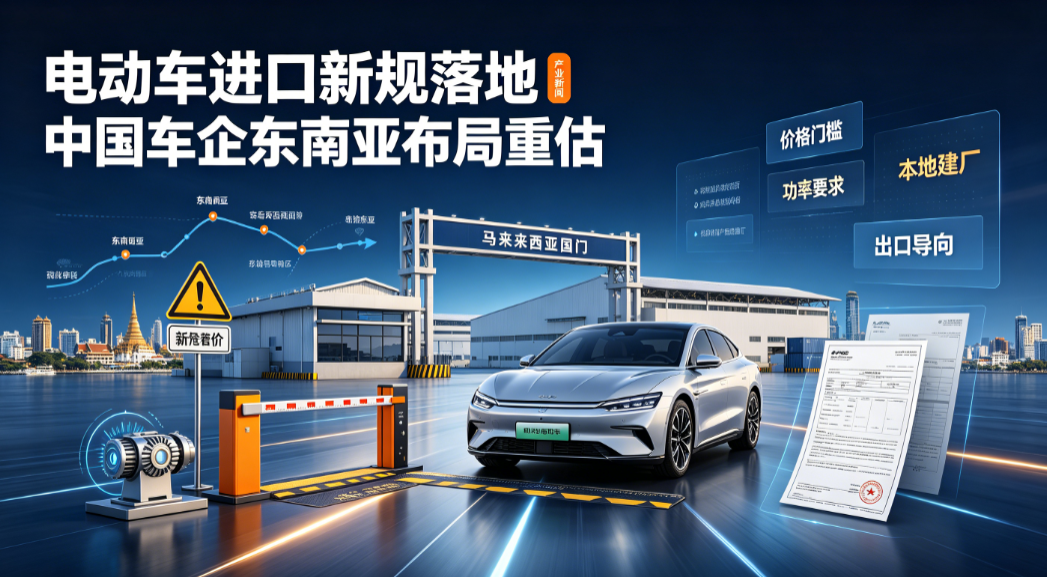
Starting July 1, all fully imported EVs entering Malaysia must meet two new conditions: a minimum landed cost of no less than 200,000 ringgit, and a motor output of at least 180 kW. On top of that, import duty, excise duty, and sales tax have also returned. The message is clear: Malaysia is no longer willing to serve as an unrestricted low-cost landing zone for imported EVs.

For Chinese carmakers, the shift is more than a pricing adjustment. It marks a structural change in the rules of competition. The age of relying on tax exemptions and price advantages to win market share is drawing to a close. Going forward, success in Malaysia will depend on localization, industrial integration, and, above all, a willingness to treat the country not merely as a sales destination, but as a production and export base.

From Policy Dividend to Policy Discipline

Between 2022 and 2025, Malaysia used a temporary incentive framework to accelerate EV adoption. For EVs priced above 100,000 ringgit, the government waived import and excise taxes and applied only a 10% sales tax. This policy created a powerful opening for overseas brands, especially Chinese manufacturers that already had strong cost advantages and mature electric platforms.

The results were visible quickly. In the 2025 Malaysian EV sales rankings, brands such as BYD, Zeekr, Chery, XPeng, and Denza all appeared in the top tier. Proton, ranked second, was backed strategically by Geely. BYD, in particular, became a symbol of how quickly a Chinese brand could scale under favorable policy conditions, leading Malaysia’s EV sales for three consecutive years.

Encouraged by that momentum, BYD announced in August 2025 that it would establish a CKD assembly plant in the KLK Technology Park in Tanjung Malim, Perak. The planned annual capacity was 50,000 units, with an estimated investment of 1.3 billion ringgit. After receiving a temporary manufacturing license in late September, the project moved forward rapidly.

Then the policy environment changed.

By March 2026, local media reported signs of a possible slowdown in the construction of BYD’s Tanjung Malim plant. Rumors spread online that the government was requiring 80% of the plant’s output to be exported, or that locally sold vehicles could not be priced below 200,000 ringgit. Although Malaysia’s Ministry of Investment, Trade and Industry (MITI) quickly denied those claims, the clarification itself underscored the deeper problem: the ground had shifted beneath the feet of foreign investors.

MITI explained that the new rules were not specific to BYD. Instead, they were part of a broader framework introduced in September 2025 for all new automotive investment projects, except those using existing local assembly facilities. The actual requirement was that the plant could sell no more than 10,000 units per year in the local market, which represented 20% of the planned capacity. For CKD vehicles, the local on-road price floor was 100,000 ringgit, not 200,000.

Even so, the policy impact was real. In the case of BYD, the company’s most popular models in Malaysia, including the Dolphin, Atto 2, and Seal, are positioned around the 100,000-ringgit level. Under the new structure, it can no longer rely on volume-based pricing to dominate the market. It must also deal with localization requirements that include welding, painting, and final assembly operations in Malaysia, all of which raise costs and complicate its business model.

The result is a strategic dilemma. A pure import strategy is now much less viable. But building a dedicated local plant is expensive and comes with hard limits on domestic sales. The old formula no longer works.

Why Malaysia Is Tightening the Screws

It is tempting to interpret Malaysia’s new rules as an anti-China move. That would be too simplistic.

The government’s rationale is rooted in industrial policy. Malaysia wants to protect its domestic automotive ecosystem, preserve employment, and avoid becoming a dumping ground for excess EV capacity from abroad. MITI and its leadership have stressed repeatedly that the rules are designed to encourage sustainable, high-value local manufacturing rather than simple product importation.

This matters because Malaysia’s automotive sector is not starting from zero. Local brands such as Perodua and Proton account for more than 60% of the passenger-car market. Around them is a mature supplier network of hundreds of parts makers, supporting more than 700,000 jobs. For policymakers, this is not just an industrial system; it is a social and economic pillar.

At the same time, Malaysia wants foreign investment to contribute to trade balance and supply-chain integration. That is why the new policy is export-oriented. The government is not trying to cap factory capacity in the abstract. It is trying to ensure that investment creates local value, supports domestic suppliers, and connects Malaysia more deeply to regional and global manufacturing networks.

In that sense, the policy shift is not unusual. As a market matures, governments tend to move from incentive-driven openness to conditional openness. They want the benefits of foreign capital, but they also want local capabilities to rise. The days of tariff-free, low-friction market entry rarely last forever.

Chinese Carmakers Are Splitting Into Different Paths

Faced with this changing landscape, Chinese automakers are no longer following a single strategy. Instead, they are dividing into several models of localization.

One approach is to build independent production capacity. Another is to enter through joint ventures or to share existing local production lines, thereby lowering policy risk and embedding themselves more deeply in the local industrial chain.

Chery is a clear example of the first path. In the Beringin high-tech automotive park in Selangor, its smart vehicle industrial park is under construction through a joint venture with local capital. The first phase is planned for 100,000 units annually, expandable to 300,000 units, with production expected to begin in the second half of 2026.

Chery already holds one of the earliest formal vehicle manufacturing qualifications among Chinese automakers in Malaysia. Beyond the new industrial park, it operates two production bases in the country. One is a CKD assembly facility with Inokom, mainly for fuel and hybrid vehicles. The other is its wholly owned plant in Shah Alam, which began production in 2024 and focuses on the premium Jaecoo and Omoda series, as well as the iCaur EV line.

Geely chose another route. Instead of building an entirely separate factory, it entered Malaysia by investing 49.9% in Proton in 2017. Over time, this partnership has become a platform for localized EV development. Proton’s e.MAS sub-brand now has more flexible pricing thanks to local CKD assembly and Geely’s technical support, with the entry-level e.MAS 5 priced from just 56,800 ringgit.

That strategy is already showing results. Proton’s pure EV registrations reached 8,890 units in 2025, ranking second in the market. From January to May 2026, cumulative registrations rose to 11,642 units, pushing it to the top of the sales chart.

Zeekr, as Geely’s premium EV brand, is also adapting by leveraging the Proton partnership and local production assets. Its upcoming Zeekr 7X is expected to move into CKD assembly, shifting from full import to localized production without needing to build a greenfield factory.

XPeng, meanwhile, has opted to use an existing plant and local assembly capacity. Its EPMB factory in Malacca officially began production only days ago, with the first G6 rolling off the line.

These examples suggest that Chinese carmakers are becoming more pragmatic. In Southeast Asia, localization is no longer just a slogan; it is a survival mechanism.

Southeast Asia Still Matters — But the Risk Profile Is Changing

There is no question that Southeast Asia remains strategically important.

For Chinese automakers, the region offers scale, proximity, and policy diversity. In many markets, internal combustion vehicles were long dominated by Japanese brands, while EV adoption started later and local supply chains are still underdeveloped. That created a window for Chinese companies to compete through their strengths in battery systems, cost control, software integration, and intelligent features.

Governments across the region have also been eager to attract automotive investment. Thailand, for example, has offered major tax incentives through its Board of Investment, including corporate income tax exemptions for 10 to 13 years. Such incentives have helped draw in a wave of foreign manufacturers.

But incentives always come with strings attached. In Thailand, companies must meet requirements on investment scale, local sourcing, and annual output. If they fail, the BOI can revise or revoke benefits and even demand repayment of tax exemptions with penalties.

That model is increasingly becoming the norm across Southeast Asia. In the early phase, governments use incentives to attract factories. In the second phase, they use policy conditions to force localization and ensure domestic value creation. In the third phase, they use market access and export potential as leverage.

This is why the competition is becoming more complicated. Chinese automakers are not simply entering a new market; they are entering an evolving policy system where the rules are becoming stricter over time.

One executive put it bluntly: the real danger is not that the market is small. The danger is assuming that today’s policy environment will remain unchanged tomorrow.

Conclusion

Malaysia’s latest EV policy shift sends a broader message to Chinese automakers across Southeast Asia: the era of low-cost, high-speed market capture is narrowing.

The region still offers real opportunity. Demand is growing, industrialization is advancing, and export pathways through ASEAN trade agreements remain attractive. But the rules are changing. Governments no longer want to be treated as simple consumption markets. They want factories, suppliers, jobs, exports, and long-term industrial value.

For Chinese brands, that means strategy must come before scale. Localization must be designed early, not added later. Investment must be aligned with policy direction, not just short-term sales potential. And market entry must be judged not only by how quickly a brand can sell cars, but by whether it can survive the next turn in the policy cycle.

Southeast Asia remains a promising frontier. But it is no longer a frontier that rewards speed alone. It rewards patience, structure, and the ability to adapt when the wind shifts.

Related Articles