U.S. Stocks Move in Different Directions: Tech Supports the Nasdaq as the Market Searches for a Direction Between Rate Expectations and Earnings Validation
Keywords: U.S. major indices, Dow Jones Industrial Average, S&P 500, Nasdaq Composite, tech stocks, rate expectations, market divergence, investment strategy
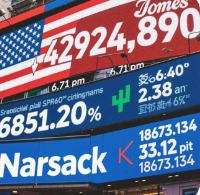
In the latest trading session, U.S. stocks continued their recent pattern of divergent performance: the Dow Jones Industrial Average and the S&P 500 both closed slightly lower, while the Nasdaq Composite moved higher, showing that the tech sector still has some resilience. At the close, the Dow Jones Industrial Average stood at 42,924.89, down 6.71 points or 0.02%; the S&P 500 closed at 5,851.20, down 2.78 points or 0.05%; and the Nasdaq Composite finished at 18,573.13, up 33.12 points or 0.18%.
On the surface, these moves look small, but in mature capital markets even tiny index changes often reflect deeper shifts in capital preference and market expectations. U.S. stocks are currently being shaped by macro variables, corporate earnings and sector rotation all at once: on one hand, investors worry that a high-rate environment will keep valuations under pressure; on the other, they hope that the continued earnings strength of tech giants can keep market confidence intact.
I. Divergence Across the Three Indices Reflects Caution
The small declines in the Dow and S&P 500 suggest that the market is not showing a unified buying force. Dow components are more exposed to traditional industrial, financial, consumer and healthcare sectors, which in the current environment are more sensitive to growth expectations and interest rates. If investors are cautious about the near-term macro outlook, traditional blue chips are usually the first to show subdued momentum or mild pressure.
The S&P 500, as a broader benchmark, also carries meaning in its slight decline. Although it includes many of America's most representative listed companies, the index's direction is still heavily influenced by large technology, communications and consumer leaders with high weights. When there is no fresh catalyst, the index often consolidates near highs, reflecting a willingness to wait for clearer policy and earnings signals rather than chase prices higher.
By contrast, the Nasdaq's gain shows that growth assets still have some favor. Because the Nasdaq is dominated by tech, internet, semiconductor and innovative growth companies, it better captures the market's preference for pricing future earnings growth. As long as the fundamentals of leading tech firms remain solid and rate expectations are not fully settled, the Nasdaq is more likely to outperform.
II. Tech Stocks Remain the Market's Core Support
The Nasdaq's relative strength is no accident. Over the past period, the main thread in U.S. stocks has revolved around AI, cloud computing, chips and software services. Tech giants, with stronger cash flow, higher margins and continued capital-spending capacity, have become the preferred holdings in an uncertain environment. For institutional investors, tech leaders are not only the most growth-sensitive names, they are also among the most liquid assets, so money tends to return to them first when risk appetite recovers slightly.
At the same time, investors are paying closer attention to earnings reports. They are no longer looking only at revenue growth; they also care about margins, free cash flow, guidance ranges and return on capital spending. For companies that keep delivering, valuations do not necessarily have to fall sharply just because rates are high. On the contrary, if a company has stable growth prospects and a strong moat, its valuation premium can still be supported.

From a sector-rotation perspective, the current market is not a broad-based rally; it is more of a selective opportunity set centered on a few core assets. Money flowing into high-quality tech companies gives the Nasdaq an edge, while cyclical sectors such as financials, industrials and energy remain relatively flat because they are more sensitive to economic momentum. This structural split shows that the preference for “high growth, high certainty” still dominates.
III. Rate Expectations and Economic Data Remain the Key Variables
For U.S. stocks, the core determinant of medium-term direction is still the Federal Reserve's policy path. If the market believes rates will stay high for longer, growth valuations may face compression. If inflation continues to ease and cut expectations rise, high-valuation tech names could keep benefiting. That is why investors remain highly sensitive to even small changes in macro data, even when daily moves are not large.
At the moment, the market is largely in a “waiting for data, waiting for signals, waiting for validation” phase. On one side, jobs, inflation and consumption data will influence rate expectations; on the other, the quality of earnings will determine whether the market can absorb the valuation levels built up earlier. For the major indices, if macro data shows a pattern of “mild slowdown but resilience,” that usually supports a sideways-to-higher trend. But if data weakens unexpectedly, risk appetite can cool quickly.
In addition, external factors such as geopolitical developments, global oil prices and cross-border capital flows continue to influence style rotation in U.S. stocks. Especially as global asset allocation is rebalanced, the U.S. remains one of the most important destinations for international capital. When funds rotate back from defensive assets to risk assets, the Nasdaq tends to benefit first; when the market moves into risk-off mode, value sectors in the Dow and S&P 500 are also affected.

IV. What Investors Should Take Away: Focus on Structure, Not One-Day Moves
Today's close shows that U.S. stocks still offer opportunities, but what is missing is a broad, all-sector upside impulse. For investors, this means strategy should focus more on structure, diversification and fundamentals rather than chasing index noise. In a backdrop of high rates and high valuations, stock selection matters much more.
First, investors should focus on companies with strong earnings visibility, healthy cash flow and clear industry leadership. These firms are more likely to attract long-term capital even when volatility rises. Second, it makes sense to look for sub-segment opportunities within tech, such as AI infrastructure, computing power, semiconductor equipment and enterprise software. These areas often have better earnings delivery. Third, traditional cyclical and defensive sectors should not be ignored, especially as they can provide valuable ballast during market pullbacks and in a slower-growth environment.
From a risk-management perspective, investors should watch for two scenarios: first, repeated high-level consolidation that raises the cost of chasing strength; and second, sudden changes in macro data or policy expectations that trigger fast style rotation. In such an environment, position control, phased entry and a reasonable cash buffer are often more effective than betting blindly on one direction.
Conclusion
Overall, the mixed close reflects a market still searching for a new balance between rate expectations, corporate earnings and capital rotation. The slight declines in the Dow and S&P 500 point to cautious sentiment, while the Nasdaq's gain shows that tech stocks remain an important pillar of support. Over the next period, whether U.S. stocks can break out of the current range will still depend on macro data, Federal Reserve signals and continued earnings validation from tech leaders.
In an environment where uncertainty remains, the market is more likely to feature index divergence, sector rotation and selective opportunities. For investors, understanding the logic behind that divergence is more valuable than focusing only on the daily move. Only by balancing earnings certainty and valuation safety margins can one achieve more stable portfolio returns in a complex U.S. market.